
.png)
National Commission for Technical and Vocational Education and Training Continues Work on Developing a National TVET Data Management System
Ramallah | 16 August 2026
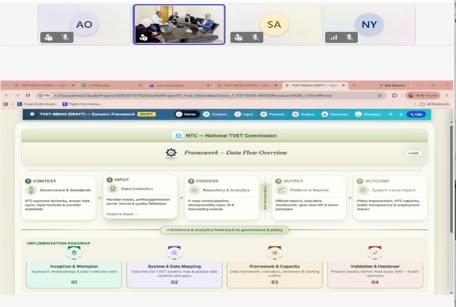
The National Commission for Technical and Vocational Education and Training continued its work today, Sunday, on developing the proposed national framework for managing information and data in the technical and vocational education and training (TVET) sector. This took place during a technical meeting held at the Commission’s headquarters in Ramallah to review the framework and discuss its key components in preparation for the next stages of implementation.
The meeting was attended by the Commission’s Vice President, Dr. Eng. Hisham Salama; Eng. Mays Abu Khalil from the Information Technology Department; and a team of experts from A2Z Consulting and Training.
Discussions addressed several key aspects of the framework, including data governance and ownership, the standardization of data definitions and standards, data sources and flows, verification and validation mechanisms, information integration among relevant institutions and entities, the development of institutional profiles, report generation, and the use of data for planning and decision-making.
This review forms part of an integrated process that began with an assessment of the current status of data systems and sources within the TVET sector and is progressing toward the adoption, review, and further development of the proposed framework in cooperation with relevant stakeholders.
The discussions highlighted the importance of establishing a national system based on standardized, reliable, and verifiable data, with clearly defined roles and responsibilities for the various entities involved. Such a system would help reduce data duplication and inconsistencies while strengthening the use of data in policy development, strategic planning, and sector performance monitoring.
Through this process, the Commission is working to establish an integrated national system for the governance and management of TVET data, enhancing the efficiency of sector management, supporting evidence-based decision-making, and providing a stronger foundation for future planning and development.